
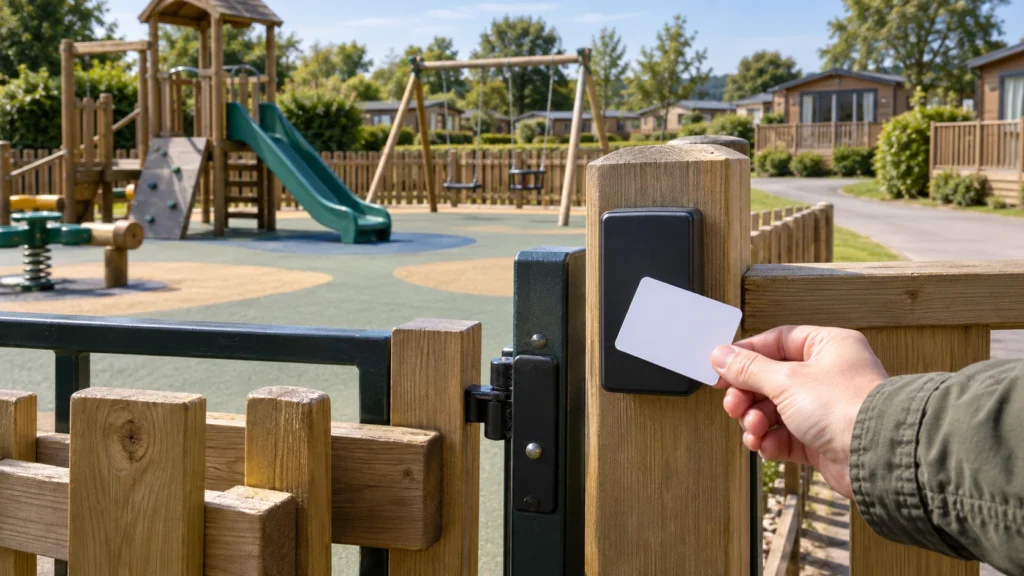
Arriving at a campsite with an access card raises a practical question: what does it actually open? The answer varies by site. A card may operate an entrance barrier, unlock a shared facility, or identify a guest for a particular service. It is worth checking its purpose when you arrive, especially if reception will be closed when you next need to get in.
What a campsite access card may control
Access cards are a way to manage entry to areas or services that are reserved for certain guests. Depending on the campsite, the same card might serve several purposes, or separate cards and codes might be used for different places. Receiving a card does not mean every facility requires it.
The most common use is vehicle access. A card may raise the entrance barrier so registered guests can drive in and out without asking staff each time. Where a site has pedestrian gates, those may use the card too. Check whether the barrier reads the card on both entry and exit; the procedure is not necessarily identical in each direction.
A card can also provide access to shared buildings, such as sanitary or laundry facilities. Some sites use a card to control a service rather than a door, for example by activating a shower or another metered facility. If a card is connected to a balance or recorded usage, ask how charges are calculated and whether unused credit is refundable. Those details depend on the campsite’s system.
Entry rights and service charges are different
A working card confirms access only to the functions assigned to it. It does not automatically mean a service is included in the accommodation price. Electricity, laundry, showers, and other facilities may have separate terms even when a card is involved.
The distinction matters when booking a camping pitch or comparing it with a cabin. A pitch with an electricity connection, for example, may still have a separate charge or usage arrangement. The access card itself tells you little about that cost. Read the booking details and ask staff how the connection is enabled and billed before relying on it.
Likewise, a locked building does not necessarily mean every activity elsewhere on the grounds is restricted. A playground, beach area, or path may have different access rules from sanitary facilities. The play areas described on the campsite are available to guests and visitors. Do not assume an access card is needed for an outdoor activity unless the site says so.
When to use the card during your stay
Use the card when the campsite directs you to present it at a reader, gate, or facility. At a vehicle barrier, stop where the instructions indicate, present the card, and wait for the barrier to open fully. Avoid following another vehicle through: the system may need to register each entry separately, and the barrier may close sooner than expected.
Keep the card accessible when leaving for the day. Imagine returning from an evening outing after reception has closed. If the card is needed at the entrance, leaving it in the cabin or with someone who stayed behind could prevent you from driving back to your pitch. Knowing whether there is another way to enter after hours makes that small planning decision much easier.
For shared facilities, check the instructions posted at the door or machine before using the card. A tap may unlock a door, start a timed service, or register a charge. If you are unsure what the reader will do, ask before presenting the card repeatedly. Multiple taps can be confusing, particularly where usage is recorded.
Questions to settle at check-in
A short explanation at reception can prevent most access problems. The useful questions are specific:
- Which gates, doors, or services does this card operate?
- Does each adult or vehicle need a separate card?
- What is the procedure for arriving or returning outside reception hours?
- Are any card-operated services charged separately, and how can charges be checked?
- What should you do if the card is lost, damaged, or stops working?
- Must the card be returned at checkout, and is there a deposit?
If you expect to arrive when reception is closed, get these details before travelling. A booking confirmation may explain how to collect a card or use a temporary entry method, but arrangements differ. Save the campsite’s arrival instructions somewhere you can reach without an internet connection. For more detailed information on this topic, read our guide on Essential Tips for a Comfortable Caravan Camping Experience.
If the card does not work
Start with the simple possibilities. Check that you are using the correct reader and following any displayed instructions. At a gate, position the vehicle as directed and try the card once more. If the card works at one place but not another, the second area may not be included in your access.
Do not force a gate or door, or ask another guest to admit your vehicle as a routine workaround. Contact reception or the site’s stated after-hours contact and describe where the failure occurred. This helps staff tell the difference between a faulty card, an access setting, and a problem with the reader. Keep any backup entry instructions provided at check-in available until you leave.
An access card is most useful when you understand its limits. Confirm what it opens, whether it activates any charged services, and how entry works after hours. Then keep it with the person who will need it, and follow the campsite’s instructions at each reader.